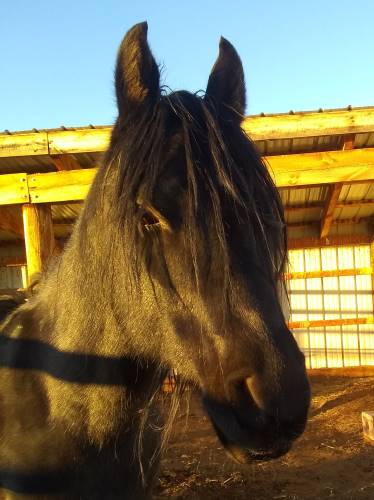
The other day I got kicked by a horse, a recently-gelded Arabian named T’Challa. I’m sure, to him, I deserved it. I was, after all, messing with his feet, where, common equine wisdom says, a horse’s brain is really located. It takes a lot of trust, that, willingly giving over your capacity for fight or flight by letting someone hold in their power your only means of escape and defense.
T’Challa is one of the Mountain Shadows Equine Revival rescue horses. At ten years old and never handled, he has to learn from scratch how to be something other than a stud. He just plain doesn’t know what to do with people. My job is to convince him that we’re good and worthy of his trust for everything from touching to grooming to eventually climbing on his back. It’s really something to be an ambassador for a whole species, to know that his outlook on us rides on me showing up and convincing him that we come in peace.
We have to learn to communicate across an impressive divide, and I don’t even have recourse to a synthesizer (Close Encounters, anyone?). The longer I volunteer with Mountain Shadows, however, the more I find myself becoming-horse as much as the horses have to learn to become-human (you know what I’m saying, Deleuze!). We develop a kind of creole. They teach me to read the swivel of an ear, a shift of weight to the shoulder. I teach them to translate an outstretched arm or the click of my tongue. I’m still learning, and sometimes I make mistakes. Learning a new language is hard. Learning how to consistently say, “people are good” is hard.
The more horses that come in to the rescue, the harder a sell this can feel like sometimes: Truth, who came in starved to the tune of several hundred pounds underweight; Hope, whose halter was left on as a youngster so that it later had to be surgically removed because it had fused into the growing bone of her face; Tesla, a yearling who was lumped in with some head of cattle to be auctioned off for meat by the pound. We people can be a pretty savage bunch. But there’s so much good, too: all of the people who have opened their homes to take in these horses, our volunteers who brave all Wyoming weathers to get them back on their feet, and our supporters who keep it all going.
I think humans would be wise to start taking a horse’s eye view of ourselves, with our brain, as they say, in our feet, to come to the dance with humility, to question our intentions, to trust only when it’s earned. We privilege ourselves as a species, but without real cause. We’d do well to get schooled by our equine neighbors.
T’Challa and I? We’re working it out. Yesterday he let me pick up all four feet to clean them without trying to give me a matched set of bruises. Next, we’ll tackle scary things like flags and tarps together. How do you say “tarp” in horse? I’m sure he’ll educate me, just as I’ll figure out how to reply, “Tarps? We eat those for breakfast.”
 Life in the Multiverse
And do they have different, dialects, too? Just to add to the challenge…
LikeLike
For sure! First I was speaking Hope, then I was speaking Truth, and now T’Challa has a whole different phonetic inventory!
LikeLike
I finally realize that this not-usual-style-for-you of short phrases is based on a horse’s movements of communication: ear flick, head shake, tail sweep, snort, etc. Brilliant!
LikeLike