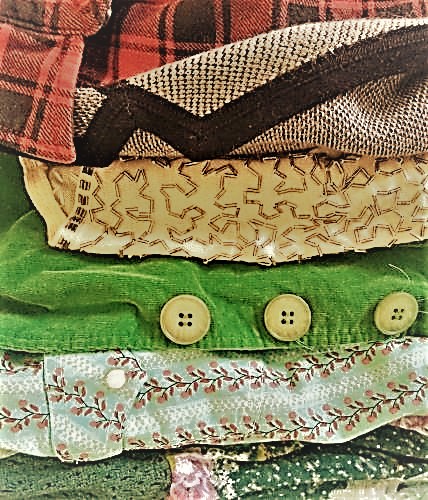
One of the virtues of decreased resources is increased resourcefulness. When I hit college, my finances got a little dire, so I started poking around the local thrift stores. Part of the appeal was not only the student-friendly price-tags, but the stylistic idiosyncrasy, the library of oddball castoffs. I never knew what I would find, and I loved to buck the carbon-copy, middle-class GAP trends I’d grown up on. Vintage candy striper shirt? Must have! Homemade fuchsia bouclé maternity coat with plastic flower buttons? Can’t not! It didn’t hurt that I went to college in California’s Bay Area, where wacky was pretty much available on tap.
Now, with the rate the kids grow, I can’t conceive of buying new clothes when they only wear them for a season. When they do grow out of theirs, or I fall out of love with some of mine, I donate right back for someone else to get some use out of them. Since thrift stores generally benefit local non-profits, this supports the community as well, rather than greasing corporate palms.
Even though thrifting is no longer strictly speaking a financial necessity for us, I have also continued to thrift because it just plain seems more ethical. There’s so bloody much mass-manufactured sweatshop crap in the universe. Why add to it by buying new mass-manufactured sweatshop crap when there is still plenty of the old to hand? If we don’t re-use, it all ends up in the dump. Not only is this a huge waste of still-viable items, but a major environmental concern, and it enables an abusive financial system.
I was fortunate enough to live with my grandmother for a time after college. She was one of the most resourceful people I have ever had the pleasure to know, and also one of the most joyful. She sometimes struggled to keep her family going on the frayed end of a shoestring, and I will never forget how her face lit up talking about the rare treat that was a can of condensed milk. She used everything down to the last drop and shred, and yet was unfailingly generous. Pleasure was a simple thing, born from maximum economy, not in the monetary sense, but in the sense of an aversion to wastefulness and excess.
It has become my habit to always make a first pass at the local thrift stores before resorting to retail for just about everything except underwear. That includes clothes, furniture, kitchenware, linens, toys, books, sports equipment, and art. All this stuff has a life-cycle, too, a turning web that doesn’t need to end with the trash can. When our pants get holes in the knees, they become shorts; when our shorts wear thin in the seat, they become doll clothes; and when the girls grow out of their dolls, they find a new home with a new kid to love them.
Thrifting isn’t just about saving money, though it’s great for that, too, but about helping create circles in place of straight lines, about rethinking purpose and rejecting a culture of disposability. Weirdly, it gives a kind of life to things. It starts to build respect for what our resources represent. That pillowcase that is fabric, that is cotton, that was a growing, living thing, that grew in soil, sun, and water, that someone put their valuable time into picking, transporting, weaving, sewing, and packaging. The pillowcase has a life, and when it’s too threadbare to do much for my pillow, it’ll make a handy dustrag or maybe bandanna.
Our vision with respect to objects is extremely limited. They are not just what the factory makes them, but have the opportunity for many more reincarnations. There’s a real, lived kind of poetry in that.
 Life in the Multiverse
And then there are the red velvet couches that have to be left behind…
LikeLike
I’m never living that one down, am I? 🙂
LikeLike
Outstanding wisdom which I failed to adopt. Now in Old Age, I get it🙃
Sent from Xfinity Connect App
LikeLike